ManufacturingBy Dr. Ramesh Patel, Chief Agronomist
Global Fertilizer Blenders Guide: Formulating Compound NPK with Zinc, Iron & Copper Sulphates (Compatibility, SGN Matching & Segregation Control)
Published on 2026-09-2815 mins readFCO 1985 & ISO 9001:2015 Verified
Executive Summary & Key Takeaways
An industrial engineering manual for NPK manufacturing plants. Learn particle Size Guide Number (SGN) matching, chemical compatibility matrices, and anti-caking protocols.
Table of Contents (Jump to Section)
Around the world, agricultural productivity increasingly relies on tailored compound fertilizers that combine primary macronutrients (Nitrogen, Phosphorus, Potassium) with essential secondary and micronutrients in a single application. Regional fertilizer blenders and compound granulation plants produce custom grades such as NPK 15:15:15 + 2% Zn, NPK 20:10:10 + 1% Fe, or NPK 12:32:16 + 1.5% Zn + 0.5% Cu tailored to regional soil fertility maps.
However, incorporating mineral salts into bulk dry blends or granulation drums presents complex chemical and mechanical challenges. Without strict control over particle sizing, moisture thresholds, and chemical compatibility, blends suffer catastrophic ballistic segregation during transit, severe caking inside storage silos, or chemical reversion of water-soluble phosphorus. This technical manual details the engineering parameters necessary to formulate stable, homogeneous compound fertilizers using high-purity mineral sulphate salts.
The SGN Rule: In any bulk dry blend, the SGN of all ingredients must not differ by more than 10% to 15% (maximum ±20 SGN units). Blending standard fine crystalline powder with granular DAP results in immediate segregation during truck transport.
1. The Physics of Ballistic Segregation & Particle SGN Matching
In dry bulk blending, physical segregation is the primary cause of commercial regulatory non-compliance. When fertilizer particles of varying sizes or densities are poured into hoppers, transferred via conveyor belts, or broadcast by tractor spinner spreaders, smaller or denser particles sink to the bottom while larger particles roll to the cone exterior. To prevent segregation, raw materials must match two fundamental physical indices defined by the International Fertilizer Development Center (IFDC):- •Size Guide Number (SGN): The median particle diameter in millimeters multiplied by 100. For example, a median granule diameter of 2.40 mm equals an SGN of 240.
- •Uniformity Index (UI): The ratio of the particle size at 95% retention to 10% retention multiplied by 100. A UI above 50 indicates an exceptionally narrow, uniform particle size distribution.
| Fertilizer Ingredient | Typical Commercial SGN Range | Uniformity Index (UI) | Compatibility Rating With Auron Granular Sulphates |
|---|---|---|---|
| Granular Urea (46-0-0) | 200 – 260 | 50 – 58 | Excellent Match (Minimal segregation risk) |
| Diammonium Phosphate - DAP (18-46-0) | 220 – 280 | 52 – 60 | Excellent Match |
| Muriate of Potash - MOP (0-0-60 Granular) | 210 – 270 | 48 – 55 | Excellent Match |
| Auron Granular Zinc Sulphate 33% | 220 – 260 | > 55 | Engineered Blending Baseline |
| Auron Granular Ferrous Sulphate 30% | 210 – 250 | > 52 | Engineered Blending Baseline |
2. Chemical Compatibility & Reaction Kinetics Matrix
Not all fertilizer raw materials can be physically mixed or co-granulated. Incompatible chemical pairs trigger moisture liberation, double-decomposition reactions, or volatile ammonia outgassing:- •Zinc Sulphate + Granular Urea (Compatible under dry conditions): Zinc Sulphate Monohydrate blends safely with dry granular urea if the relative humidity in the blending tower remains below 60%. The monohydrate form has strong crystal lattice water stability, unlike heptahydrate salts that liberate free water at ambient warehouse temperatures.
- •Zinc Sulphate + Orthophosphate (DAP / MAP - High Risk): Dry blending granular zinc sulphate with DAP is safe for immediate bagged distribution. However, in wet granulation drums, soluble zinc ions (Zn2+) react with dissolved hydrogen phosphate ions to form Zinc Phosphate [Zn3(PO4)2], which is completely insoluble in water. To prevent phosphate reversion in wet granulation, add zinc salts downstream in the cooler or use micro-granulated coatings.
- •Copper Sulphate + Ammonium Nitrate (Incompatible): Never mix Copper Sulphate with ammonium nitrate or calcium ammonium nitrate (CAN). Copper acts as an active catalyst in the thermal decomposition of nitrates, creating serious warehouse safety and deflagration hazards.
3. Critical Relative Humidity (CRH) & Caking Prevention
Every chemical salt absorbs moisture from the atmosphere when the ambient relative humidity exceeds its Critical Relative Humidity (CRH) at a given temperature. When two salts are combined, the CRH of the resulting mixture is almost always significantly lower than the CRH of either component alone:- •Granular Urea CRH at 30°C: 72.5%
- •Zinc Sulphate Monohydrate CRH at 30°C: 85.0%
- •Urea + Zinc Sulphate Mixture CRH at 30°C: 58.0% – 62.0%
4. Rotary Drum vs Vertical Ribbon Blending Mechanics
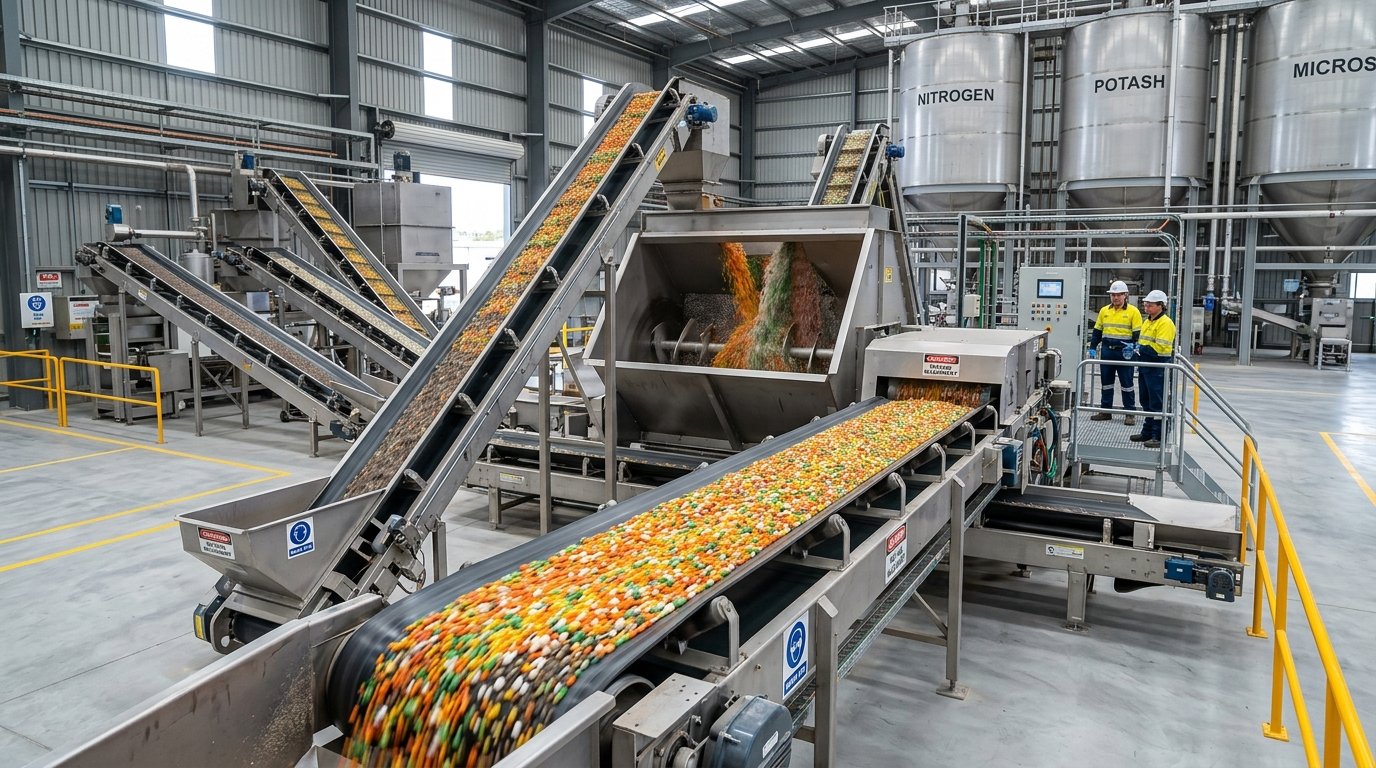
Achieving homogeneous nutrient distribution across every 50 kg commercial bag requires matching blending equipment to particle mass:- •Rotary Drum Blenders: The gold standard for commercial bulk fertilizer blending plants handling 30 to 100 MT per hour. Gentle lifting flights roll the granules without abrasive fracture or dust generation. Typical mixing cycle: 90 to 120 seconds.
- •Vertical Ribbon / Auger Blenders: Cost-effective for low-capacity regional plants (5–15 MT/hr). However, high-speed augers can shatter brittle crystalline edges, generating fine dust that promotes caking. Limit screw rotation speed to < 45 RPM.
5. Frequently Asked Questions (FAQ)
- •Q: Why is Zinc Sulphate Monohydrate superior to Zinc Oxide for compound NPK blending?
- •A: While Zinc Oxide has a higher total percentage of raw zinc (72%), it is completely insoluble in water. When broadcast by farmers, zinc oxide particles remain inert in neutral or alkaline soils. Zinc Sulphate Monohydrate 33% provides 100% water solubility and immediate plant root assimilation.
- •Q: What is the recommended dosage of anti-caking agent for bulk NPK blends?
- •A: We recommend 1.5 to 2.5 kg of paraffinic mineral oil blended with specialized alkylamine surfactants per metric ton of finished compound fertilizer.
Direct Manufacturer SourcingAuron Fertilizers · Ahmedabad, Gujarat
Procure High-Purity Micronutrients Directly from our Factory Desk
Eliminate middleman trader markups. Save 5–8% on bulk truckloads and 20ft FCL export containers with guaranteed AAS assay reports and anti-caking moisture packaging.